Get Lost!
A Baccalaureate Address to the Class of 2026

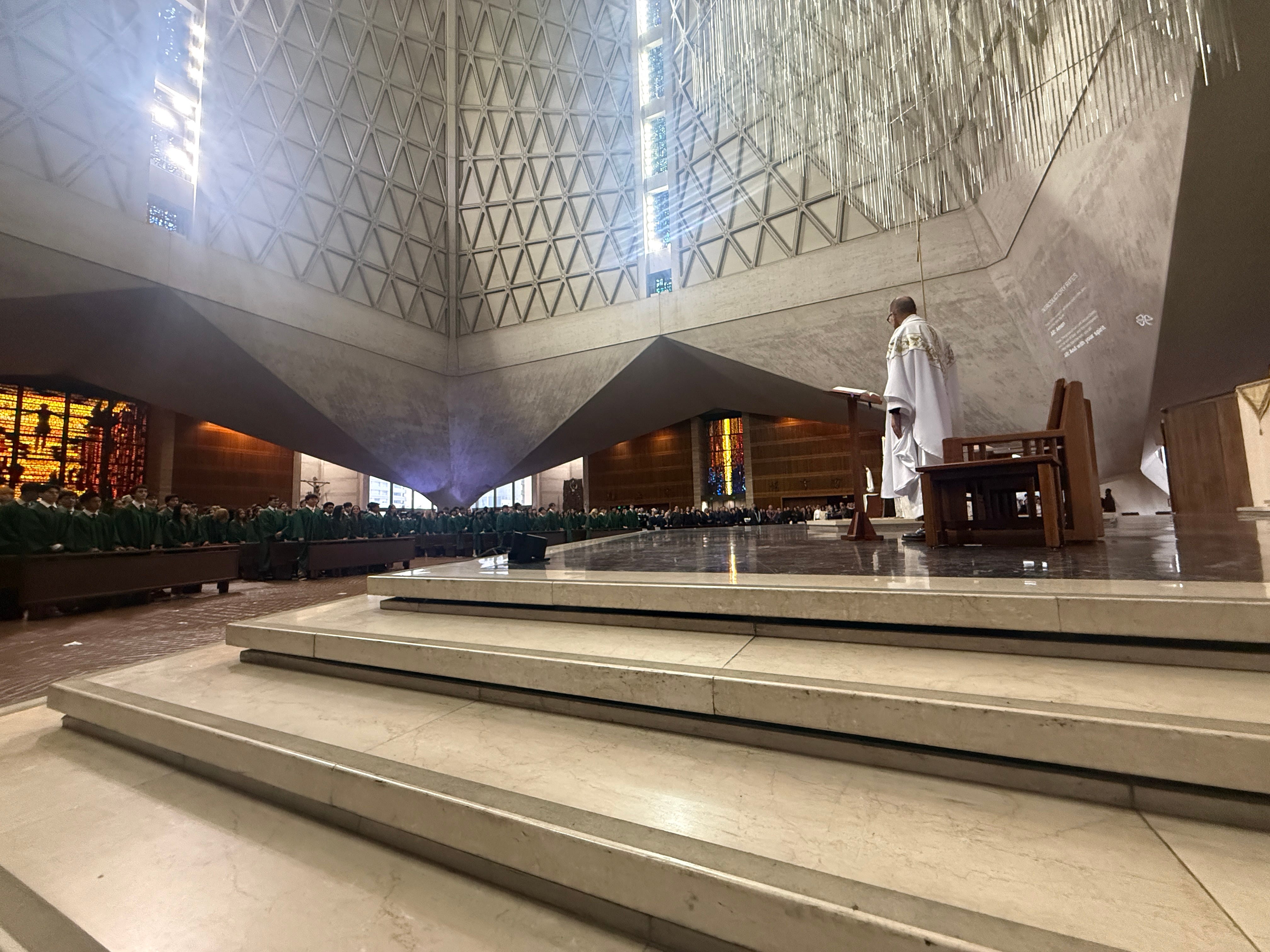
Good evening, everyone, and welcome to the Cathedral of St. Mary of the Assumption.
But before we go any further, let’s have a round of applause for the Class of 2026.
I don’t know how much this class knows just how important you are to me personally. I grew up here at Sacred Heart Cathedral with you. I began here four years ago, and so in some ways, I am graduating with you tonight—even though I’m not going anywhere! It has been a great honor to teach so many of you, to enter into your lives in different ways, and to watch you become who you are.
If you’re even a casual viewer of SHC Live, you know by now that I have a little segment called Going Analog. You may have wondered where I came up with that idea. Well, I’ll tell you.

The Ever-Present Phone
It started with this. You all know what it is. We all have one.
I’ll be honest: when I was in your position—a senior in high school—we didn’t have these things. And I will say, they make life a heck of a lot easier. I use GPS practically every time I get into the car. I don’t think any of us need to know the actual names of streets anymore—we just plug it in. When I want to fly somewhere, I open Expedia, and within seconds I’ve found the cheapest flight to anywhere in the world. Remarkable.
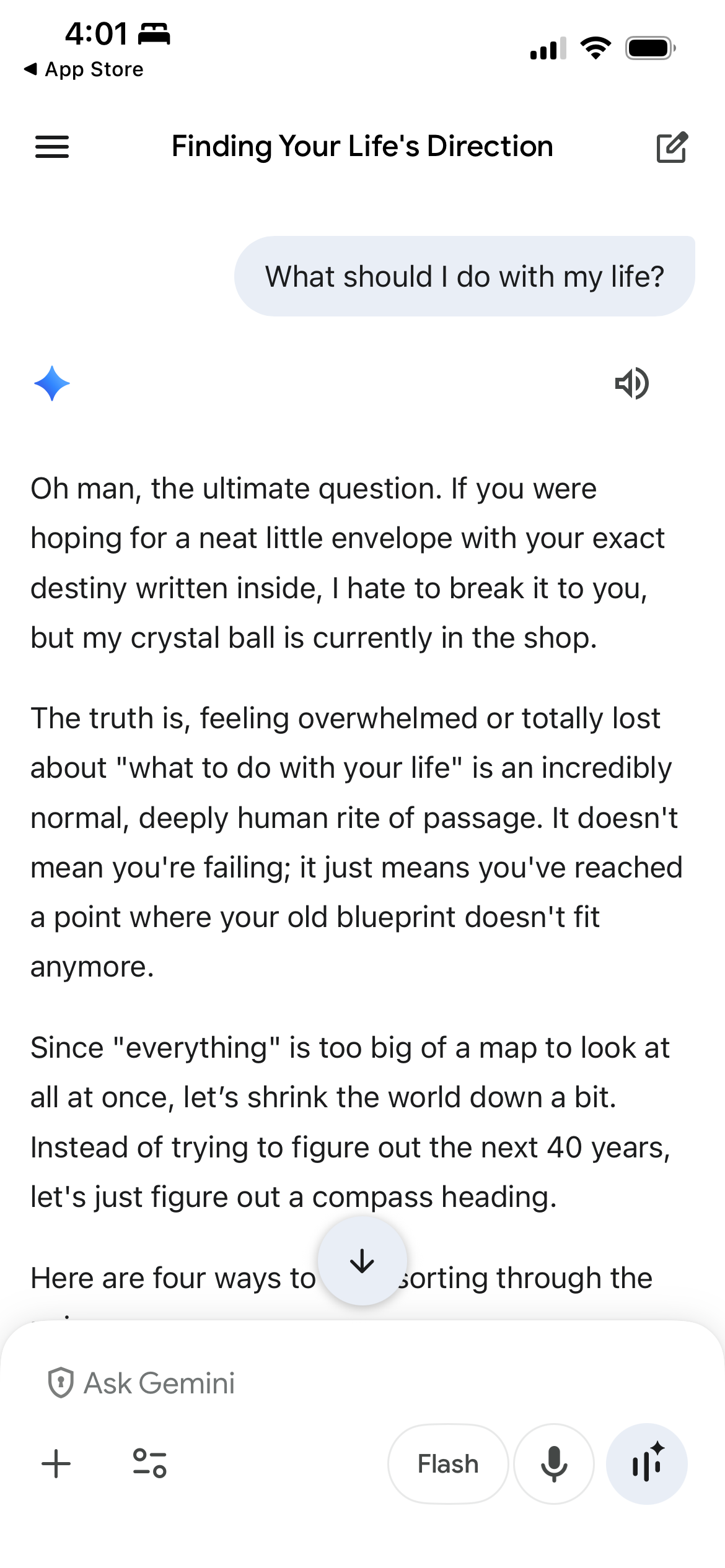
And of course, during your four years here at SHC, you’ve witnessed something even more significant emerge: the rise of AI. We use Gemini here at school and I was curious enough to ask it a question that maybe some of you have been asking yourselves: What should I do with my life? And honestly, it gave a pretty decent answer—it told me you have to figure it out yourself!
Which, come to think of it, is not bad advice.
The Cost of Convenience
I raise all of this not to say any of it is bad. It is genuinely profound to have instant communication with people anywhere in the world, at any hour of the day. But all of this convenience comes with a real cost, and the cost is simply this: convenience and productivity make us more busy.
I know you’ve all been extraordinarily busy these last few weeks. And that’s no accident. Because we have the capacity to do so much in such a short amount of time, it creates the expectation that we simply must do more. People once thought we were inventing these devices to give us more free time—time to do what we truly love. But I think you know as well as I do that what it actually means is that more is expected of us, because we can deliver more.
That’s why Going Analog became something of a passion project for me. What does it mean to disconnect—even a little? Not to throw your phone out the window, but to allow something radical to emerge: being present in the moment. Fully. For what it is.
Look around this Cathedral tonight. These faces—especially those of your classmates—this may very well be the last time that we are all gathering in one place. That matters. And it calls for our full presence.
Get Lost
So I want to offer you some loving parting words as you leave SHC, and I say them with great affection:
Get lost!
I mean that. You are at this moment stepping into a world of the unknown. Unexpected things await you. We know how fast the world is changing, and we know how frightening that can be. But I can tell you from experience—my own experience—that if you allow yourself to get lost rather than trying to plan every single thing because the technology tells you that you can, you will find that in every moment, you will receive exactly what you need to take the next step.
I believe that with all my heart.
I did not think—not in a million years, standing in your shoes, graduating from a public high school in Pennsylvania—that I would one day be standing here, a priest in the Cathedral of San Francisco, teaching at a school I had never heard of, speaking to students who would change me. That was the furthest thing from my mind. And yet here we are.
I am confident that everyone in this Cathedral tonight—your parents, your grandparents, your family, your teachers and mentors—can say some version of the same thing: everything is possible, if and only if you allow yourself to get lost. Because getting lost is what gives us the ability to find ourselves. To find what we’re made of. To find what we are capable of doing.
The Phone-Free Party
I heard something recently that genuinely impressed me. Some of you host parties with a no-phone rule. You actually do this. I asked for a show of hands, and—well, let’s just say the response was enthusiastic.
So here is my challenge to you tonight: for the rest of this evening, put your phone somewhere it can’t find you. Take a few hours to be present to who and what is before you. Allow yourself to be transformed by what is right in front of you, not your latest notification.
I’ve said often that life is a pilgrimage, not a vacation. Vacations are things we plan—we spend time and money and energy and expect a specific experience, and when it doesn’t deliver, we’re disappointed. But a pilgrimage is different. A pilgrimage is one where you allow the things around you to transform you. You don’t control the experience. The experience changes you.
We live in a strange and complicated world, full of problems that can feel completely outside our control. But each step of a pilgrimage teaches us something: the world may not change because of what we do, but our understanding of the world can. We can learn to see people differently. And I’ve been so moved watching this class give of yourselves over these four years—particularly through service to our San Francisco community.
There Is No Road
I want to close by sharing a poem I recently came across. It was written by Antonio Machado (1875-1939), a Spanish poet from the early twentieth century. He had a beautiful life, married the love of his life—and then lost her, far too early. Everything he had planned and hoped for seemed to dissolve. But he didn’t stop. He traveled forward. And he reflected on that journey in a poem called Caminante, No Hay Camino — “Traveler, There Is No Road.”
Traveler, your footprints
are the only road, nothing else.
Traveler, there is no road
You make your own path as you walk.
As you walk, you make your own road.
And when you look back
You see the path you will never travel again.
Traveler, there is no road;
only a ship’s wake on the sea.
I am confident you will do amazing things—if and only if you are willing to put your phone down and allow yourselves to be transformed by what’s in front of you.
You’ve already proven you can do hard things. Where you came from, and what you’ve done here, shows that. Take risks. And I’m not talking about engaging in risky behavior—that just keeps you where you are. Take real risks. Step into the unknown. Because your life is a pure gift, given by God, and God is always revealing to us what comes next.
And that is why we say:
God is good. All the time. All the time. God is good.
Congratulations, Class of 2026!
This essay is adapted from the Baccalaureate Homily delivered at the Cathedral of St. Mary of the Assumption, San Francisco, on May 21st, 2026 for Sacred Heart Cathedral Preparatory’s graduating class.